
Informing Policymakers
Leaders and lawmakers from both parties agree that statecraft tools are essential to safeguarding America’s national interests and global leadership.
The Gates Global Policy Center is contributing to and building on this point of agreement. We require our recommendations for adapting the nation’s nonmilitary instruments of power to 21st-century challenges to be pragmatic and nonpartisan—and therefore capable of gaining support on both sides of the political aisle.
Our forums bring Republicans and Democrats together to contribute their ideas and perspective and convey our resultant recommendations to their colleagues. We advise Congress and policymakers on how to effectively reform and restructure our national institutions of power, and policy.
Meeting a Need: Statecraft Simulations
Recent meetings with Congress, government and business leaders identified a weakness in American geoeconomic statecraft: Economic tools—such as sanctions, export controls, industrial policy, and supply-chain security—often are used without an operational picture of tradeoffs, escalation dynamics, and next-order consequences. The U.S. also routinely fails to integrate economic policy with other foreign-policy instruments.
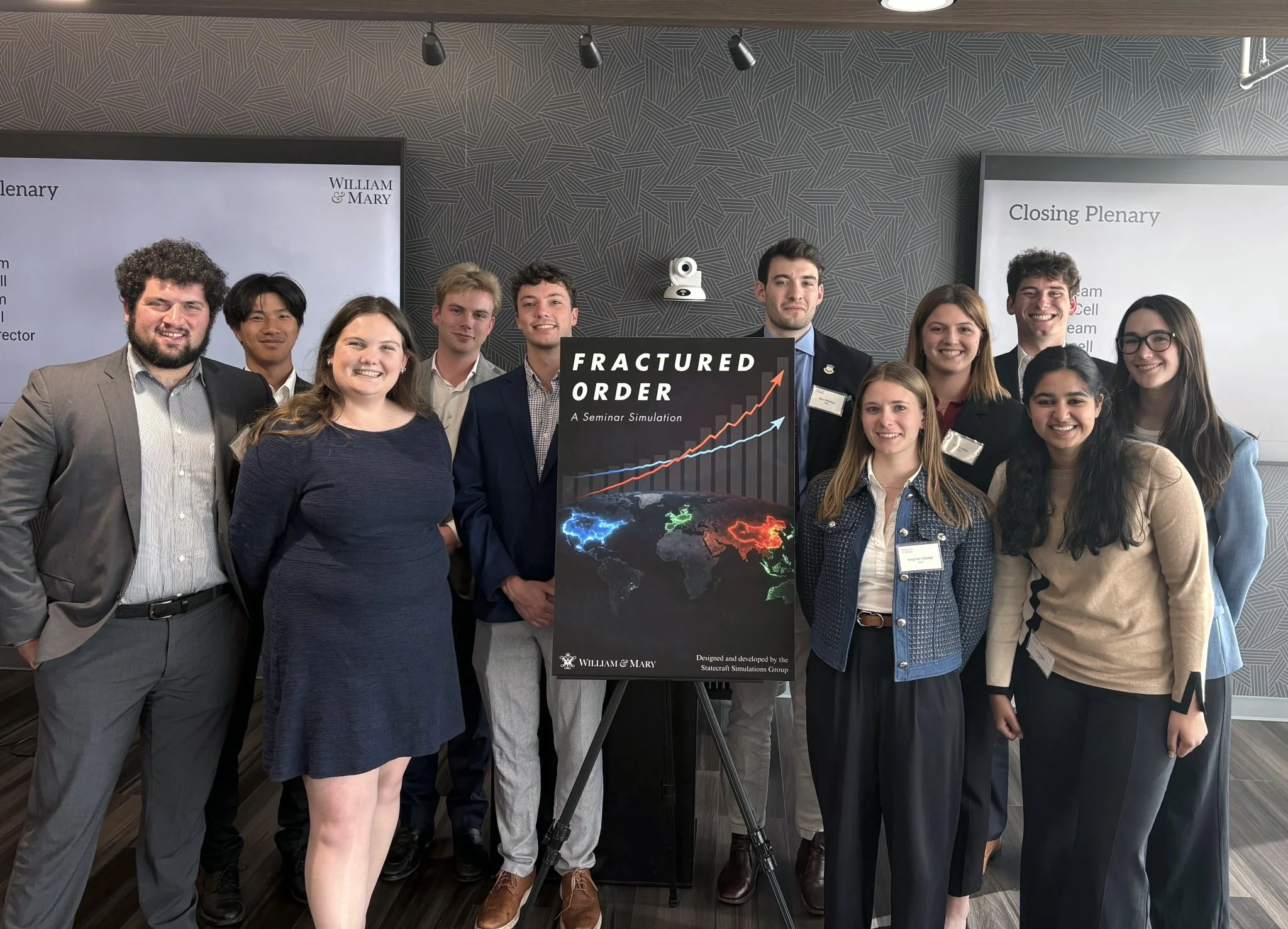
To remedy this, the Gates Global Policy Center and its research partners at William & Mary formed a Statecraft Simulations Group to design and run high-end, decision-focused, immersive strategy games to generate actionable insight on deploying U.S. statecraft tools to achieve national security goals.
Crafted and facilitated by gamemaster Maj. Gen. (AF-Ret.) Charles Lyon and William & Mary’s Statecraft Simulations Group, the simulations bring together thought leaders from Congress, the executive branch, the private sector, and allied countries to play out various geopolitical scenarios to see what works, what fails, and what coordination mechanisms are missing.
Applicable to all national security challenges, Statecraft Simulations offer significant payoffs: faster learning cycles, fewer self-inflicted costs, stronger allied alignment, and strategic discipline and integration of policy in an era of geopolitical rivalry. We will continue to refine Statecraft Simulations and expand them.
We see room for positive change in both the near and long terms. Our recommendations for how to rethink and more effectively use statecraft tools offer roadmaps for augmenting national security and competitiveness. As the American political landscape evolves, we will continue to help leaders use them.